
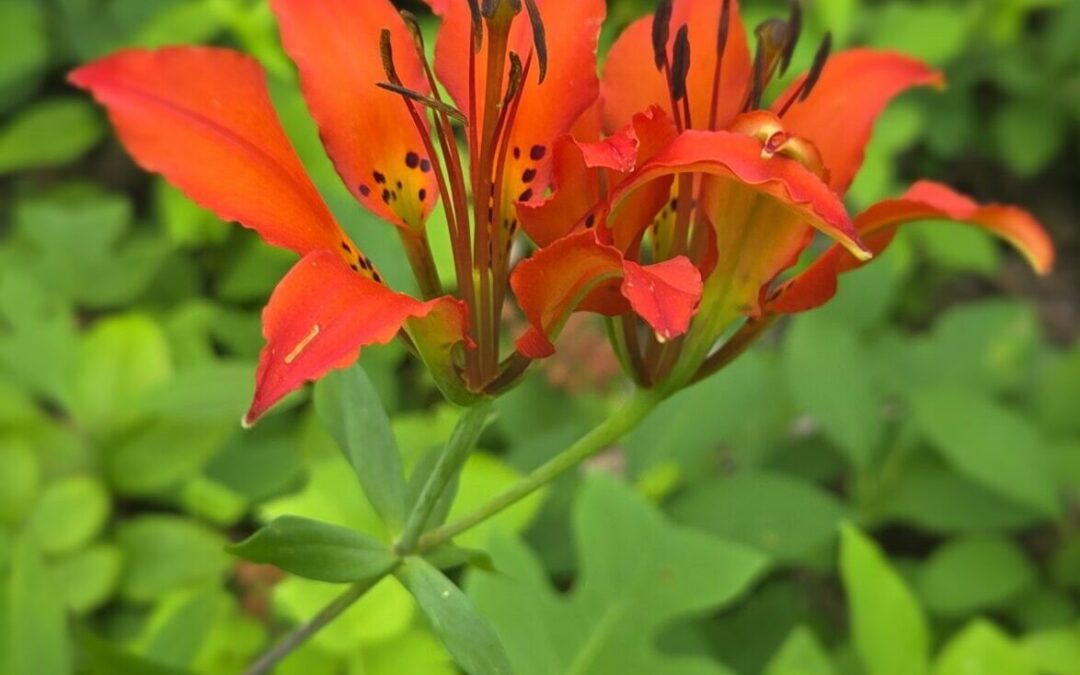
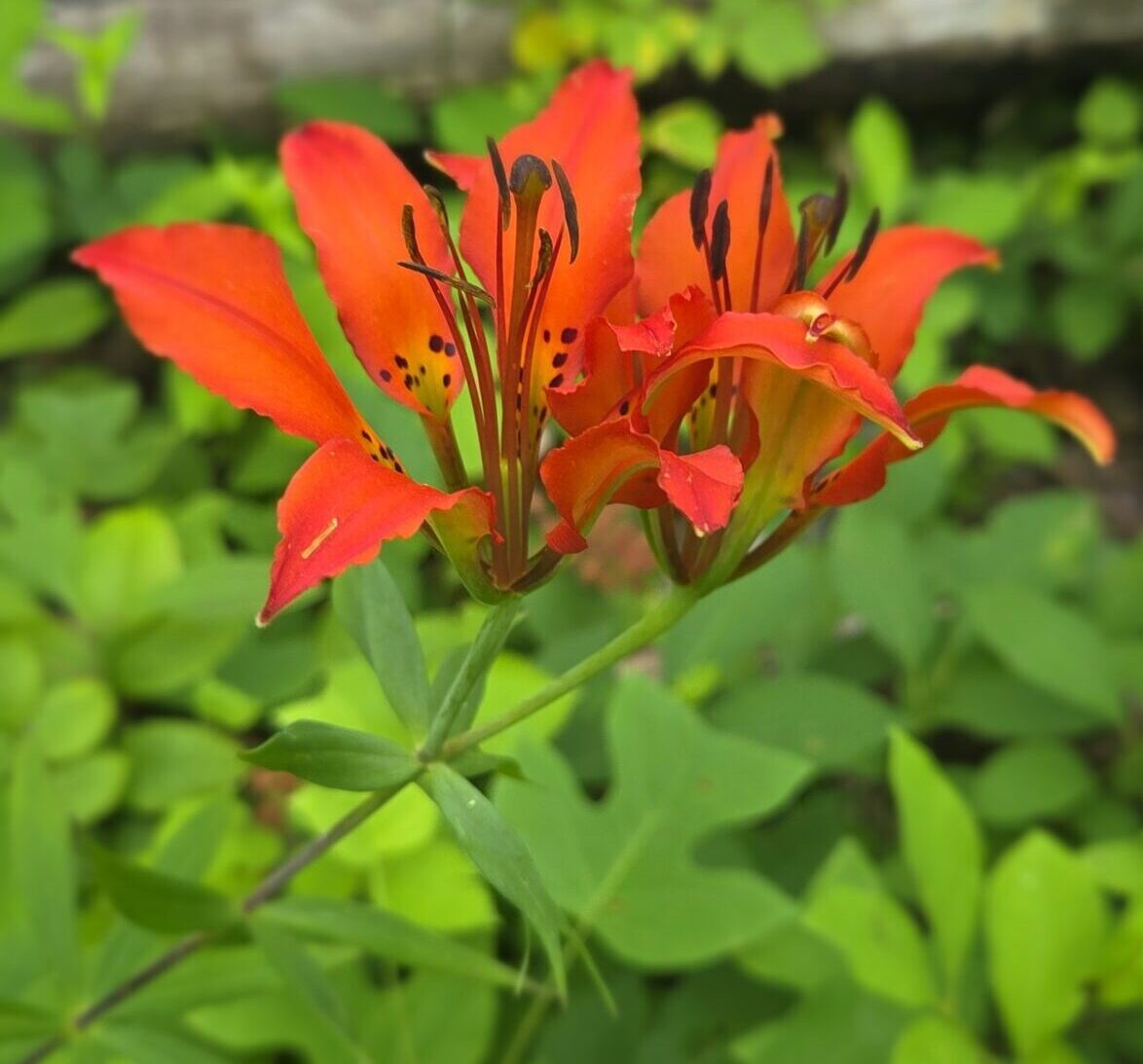
Wood Lily at MCR photo by John Parke
While performing vegetation regeneration survey work at one of MCR’s ecological forestry cuts recently, surveyors from New Jersey Audubon found a very rare plant for NJ. The plant, the Wood Lily (Lilium philadelphicum) is an endangered native wildflower in New Jersey. The plant was confirmed by MCR staff who also found a second individual plant in close proximity to the other.
Tracked by the NJDEP Office of Natural Lands Management, Wood Lily carries an S2 state rank, meaning it is considered imperiled due to extreme rarity, with only 6 to 20 known reproducing populations remaining in the state. It features showy, upright, fiery red-orange cup-shaped flowers with purplish-brown spots, blooming from June to July. The plant naturally grows is environments of open canopy woodlands, open glades, as well as, open upland early successional fields/young forest, thickets, including powerline right-of-ways and sandy plains.
The main cause of the decline of Wood Lily in NJ is natural succession to closed canopy forests and fire suppression. It also is browsed by deer. The species historically thrived in open areas maintained by periodic wildfire disturbance, however with fire being suppressed it is harder to establish new patches of the plant without active ecological forest management such as forest thinning and/or harvest to create tree canopy gaps. These tree canopy gaps provide additional sunlight to the forest floor thus stimulating the native seed bank. Wood Lily bulbs can remain dormant for years before re-emerging when conditions favor growth (i.e. appropriate light, moisture, temperature conditions triggering dormant seed).
MCR has been implementing ecological forestry practices under its NJDEP approved Forest Stewardship Plan (FSP) for several years. However, over the last 3 years, specific forestry treatment practices including harvest and forest stand thinning at a much larger scale have created habitat conditions that do stimulate growth of native vegetation. In fact, prior to implementing these large-scale practices, two botanical inventory studies for the entire MCR property were performed in 2014 and 2022 and some of the native plants that we are now seeing growing in the forest treatment areas were either: not found at all on the property during the botanical surveys or were not found in various forest treatment areas prior to treatment. Examples of some of these plants that are now being found in the treatment areas are American Hazelnut (Corylus americana), Alternative Leaf Dogwood (AKA Pogoda Dogwood) (Cornus alternifolia), Green Milkweed (Sclepias viridiflora), Showy Orchis (AKA Showy Orchis) (Galearis spectabilis), and Black Cohosh (Actaea racemosa).