
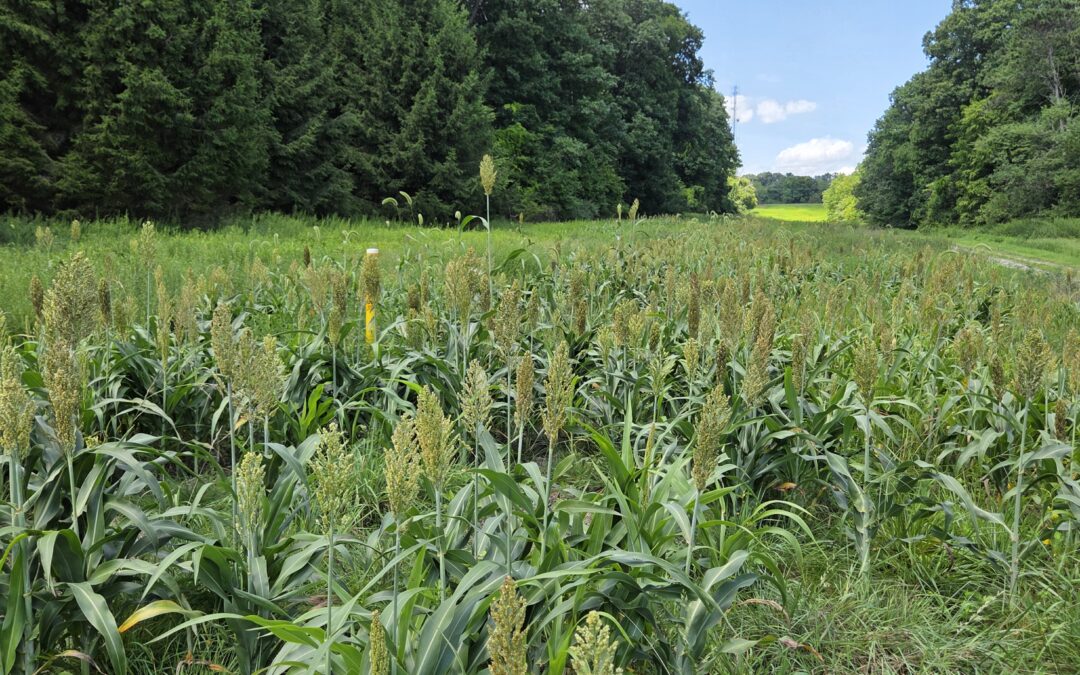
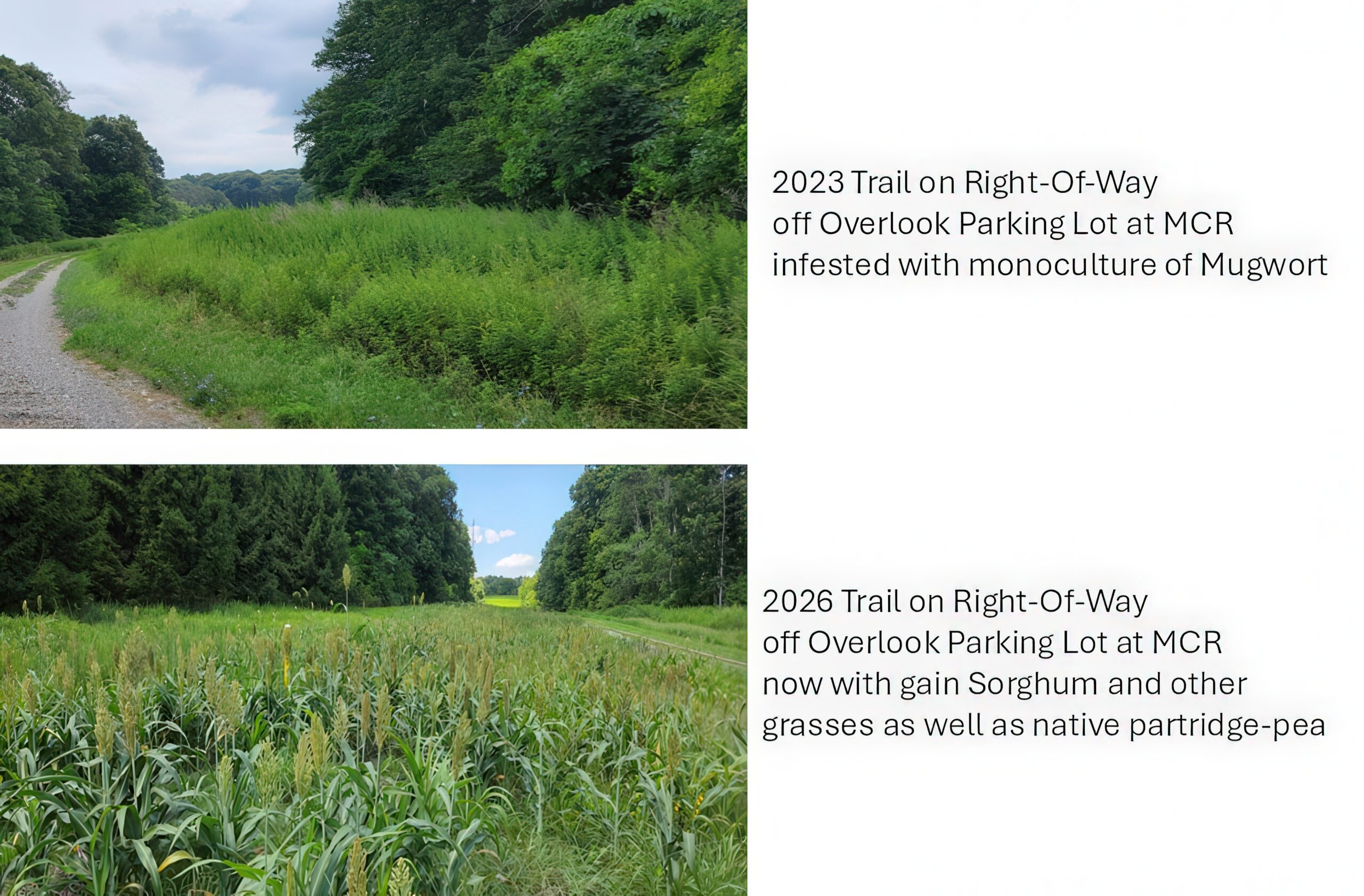
Area of ROW Perimeter Trail off Overlook Parking lot before and after mugwort treatment and restoration
Lately many visitors have been asking, “What is that plant that sort of looks like short corn along the south end of the Perimeter Trail?” Well, the answer is Sorghum (AKA milo).
Sorghum (Sorghum bicolor) is a drought tolerant cereal grass that we are using along with native warm-season grasses such as Little Blue Stem Grass (Schizachyrium scoparium) and Switch Grass (Panicum virgatum) to combat infestations of an aggressive exotic invasive plant called Mugwort (Artemisia vulgaris).
Mugwort is a perennial plant native to Europe, Asia, and North Africa and was introduced to North America in the 1600s by European settlers and Jesuit missionaries who valued it for its medicinal uses. However, Mugwort is considered to be a highly destructive invasive weed that spreads aggressively using an underground network of horizontal roots called rhizomes. Even a broken root fragment as small as two centimeters can spawn an entirely new plant. It forms dense, heavy mats that choke out native vegetation while also being an allopathic plant that releases toxic chemicals into the soil that actively prevent neighboring broadleaf plants from growing. Additionally, Mugwort is not typically browsed by deer or other mammals because the plant contains strong-smelling essential oils and tastes bitter. When left unmanaged Mugwort will take over areas ultimately growing into a monoculture.
However, establishing grasses can combat Mugwort by shading it out once the existing Mugwort rhizome network has been weakened. Over the last 3 years, Merril Creek Reservoir (MCR) has been applying broad-leaf selective herbicide to infested areas of Mugwort to kill or weaken the rhizomes. Typically, the herbicide is applied in fall when the plant will translocate the herbicide to its root system. In spring, the treatment areas are mowed and grasses are planted. Any residual Mugwort can then be spot sprayed since the type of herbicide used does not impact the grass. As the grasses establish they, over time, crowd out and shade out Mugwort that tries to re-establish.
As part of MCR’s restoration of Mugwort infested areas, native grasses were selected for establishment to provide cover for wildlife, while the sorghum, despite being non-native, was selected for forage for wildlife as it is highly compatible with conservation agriculture. Sorghum provides high-energy dependable nutrition and shelter for birds and mammals during fall and winter. Additionally, grain sorghum is a warm-season grass, thus along with other planted warm-season grasses (i.e. little blue stem, switch grass, etc), it sequesters atmospheric carbon dioxide through deep root systems and helps replenish soil organic matter. And if those ecological benefits weren’t enough, sorghum roots leak sugary compounds called exudates into the earth, which feed billions of beneficial native bacteria and fungi. This creates a living, resilient soil web that naturally recycles nutrients. Because sorghum is non-invasive and does not disrupt native ecosystems like many other introduced plants (i.e. Mugwort), its aggressive root systems and resource efficiency make it a critical tool for modern environmental stewardship.