
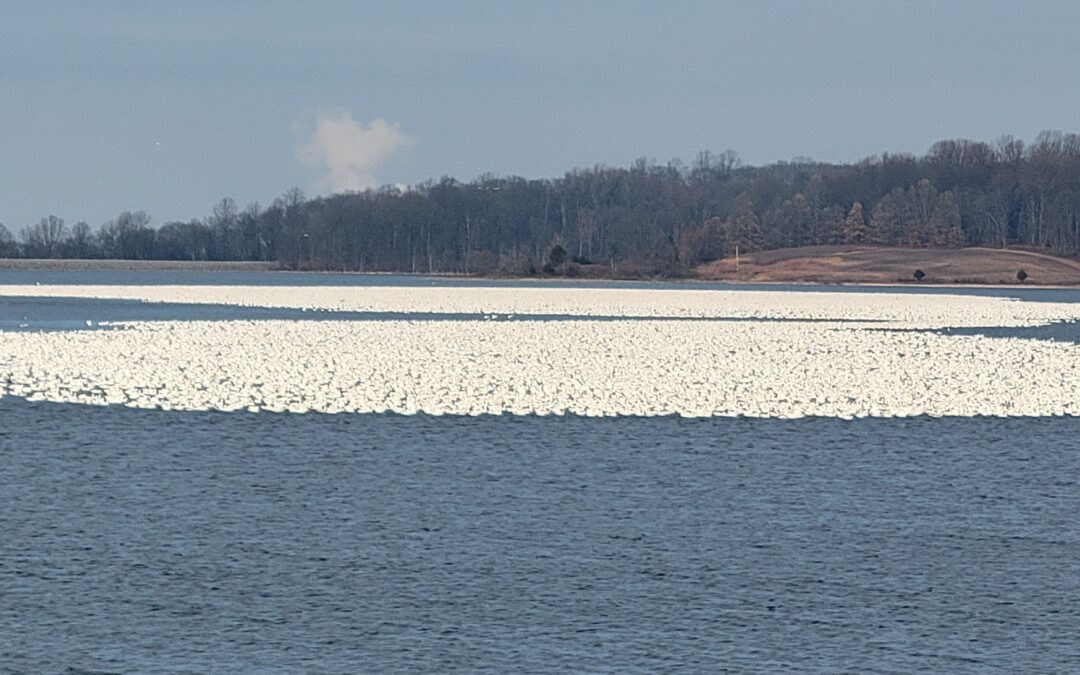
Merrill Creek Reservoir (MCR) has long been known as an important wintering/roosting area for many migratory waterfowl species. If fact, in 2005 MCR was designated as an “Important Bird & Biodiversity Area” (IBBA) primarily for this reason. An IBBA is a globally recognized site vital for bird conservation, identified by BirdLife International and partners like New Jersey Audubon and the National Audubon Society using consistent criteria for critical bird populations (breeding, migrating, wintering) or having endangered or threatened species.
One such migratory waterfowl species that MCR has become famous for each winter are Snow Geese (Anser caerulescens) that winter here and use the reservoir for roosting. Large flocks of Snow Geese (sometimes in the 100,000’s) typically arrive to the region in early December and stay to mid-March before heading back north to their breeding grounds.
According to the Pennsylvania Game Commission, “Snow geese breed in the arctic and subarctic regions of North America and Russia during spring and summer, then migrate south to spend the winter in inland and coastal areas.” In the Eastern United States, Snow Geese can be found wintering in New Jersey, Rhode Island, Massachusetts, Connecticut, Long Island (NY), Pennsylvania, Delaware, Maryland, Virginia, and North Carolina.
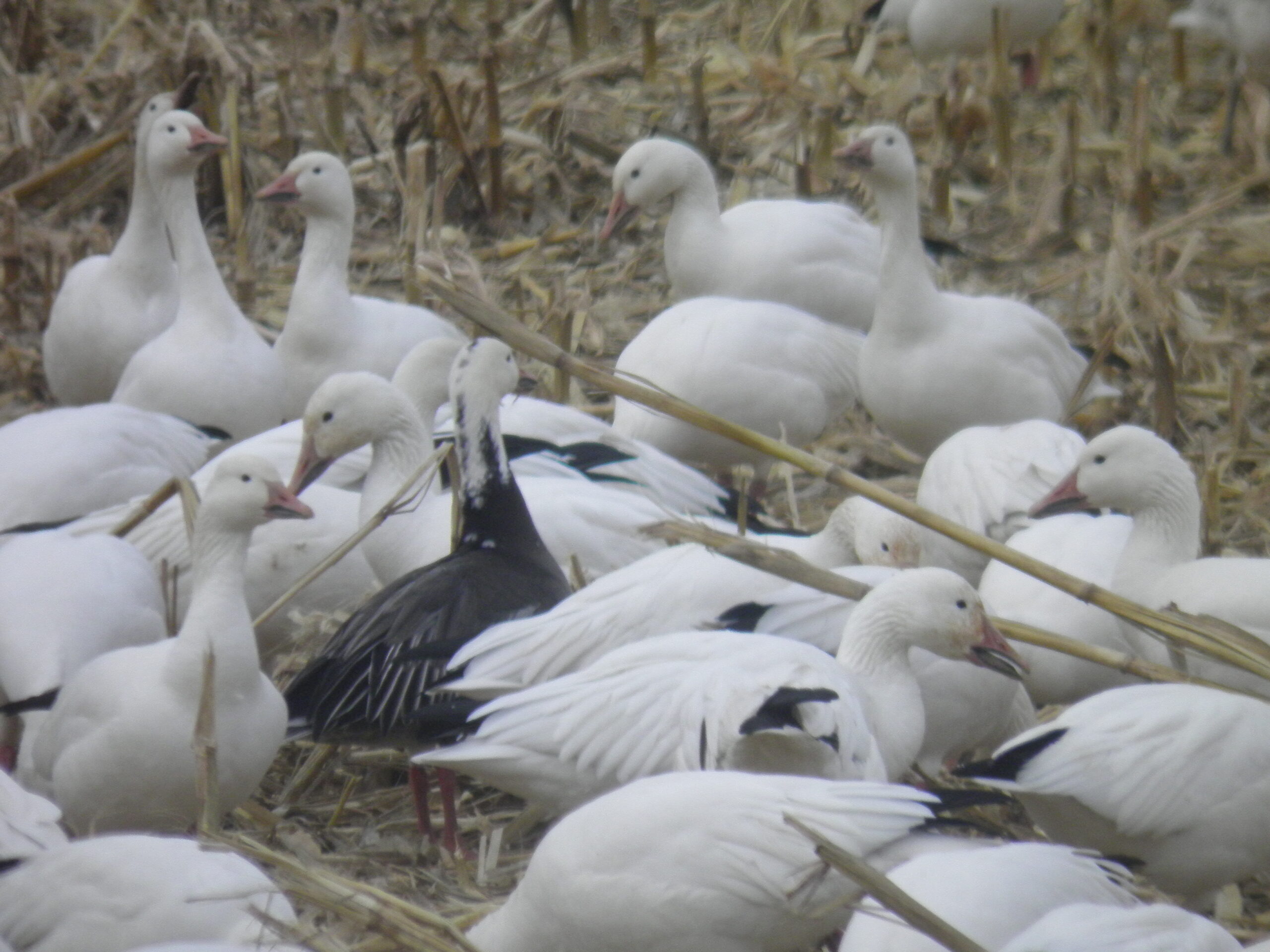
A Lesser Snow Goose (Blue-Phase) amongst Greater Snow Geese in cornfield at MCR
Additionally, “Anser caerulescens has two distinct subspecies, the Greater Snow Goose and the Lesser Snow Goose. The Lesser Snow Goose is dimorphic, which means it comes in two different colors phases, a white phase and a blue phase. The white phase is all white with the exception of black primary wing feathers. On the blue phase, the head and front of the neck are white, and the body is gray-brown, with white or gray underparts. Intermediate color forms also occur. Juvenile Snow Geese often have gray feathers rather than white. On all Snow Geese, a black patch on the edges of the bill suggests a grin or smile when viewed from the side. The eyes are dark, the bill is pink, and the legs are dark pink.”
An extremely vocal species, individuals give a loud “whouk’ or ‘kowk” sound that is repeated in flight as well as on the ground or waterbody which is said to resemble the shrill barking of a dog. Snow Geese are herbivores, meaning they eat plant materials, and are notorious for grubbing out the entire plant from the soil and consuming all of it; roots/tubers, stem, and leaves. Studies have shown that in winter, Snow Geese feed from two to more than seven hours per day. In spring, when building up fat reserves for migration, they may feed more than 12 hours daily.
According to several Bird Conservation organizations, Males and females mate for life, but will find a new mate if their mate is lost or dies. Individuals pair up during their second winter or on their second northward migration, when they are almost two years old. Generally, they first breed successfully at age three.
Snow Geese tend to group up in large flocks for protection and choose to sleep in those resting flocks by either floating on the water, or on land by sitting down or standing on one leg with their heads tucked under a wing. Research has shown Snow Geese to be strong fliers that can reach air speeds of 50 miles per hour and are capable of flying over 1,000 miles in a single day.
During migration, snow geese fly both by day and night often traveling in large flocks. They have been documented at altitudes of up to 7,500 feet during migration and fly in long diagonal lines or in V-formations, stopping at long established resting or foraging points along the way back and forth to their wintering and breeding grounds.
Research has shown that Snow Geese can live more than 26 years. However, in recent years it has been found that Snow Geese are highly vulnerable to the highly pathogenic H5N1 strain of avian influenza (AKA Bird Flu) due to their behavior of gathering in massive, dense flocks, which allows the virus to spread rapidly through nasal secretions, saliva, and feces.
Reasons for High Bird Flu Infection Rates in Snow Geese:
- Migration and Concentration: Snow Geese migrate in large numbers, often mingling with other waterfowl and using the same water sources. This high density makes transmission efficient.
- High Pathogenicity: The current circulating flu strain (HPAI H5N1) is highly contagious, causing significant mortality in wild bird populations, including large-scale fatal infections in geese species.
- Species Susceptibility: Wild waterfowl are natural hosts for influenza A viruses, and while they can carry it, this particular strain (HPAI H5N1) often results in severe sickness and is fatal, especially to juvenile birds that have not built up a strong immune system.
Furthermore, climate change impacts on snow geese are complex, creating a mix of habitat benefits and challenges, often leading to earlier breeding and altered migration patterns. Many studies on this topic have indicated that while warmer Arctic conditions promote faster spring snowmelt, which improves nesting habitat and can increase gosling production for Snow Geese on their breeding grounds, it also increases risks from predation; health problems and phenological mismatches for food availability while migrating; and habitat degradation from over grazing on both breeding and wintering, all of which will negatively impact Snow Geese in the long-run.